




Leaders for gender equality
Leaders for gender equality
Leaders for gender equality

Your support allows more Powerful Girls Develop their leadership skills and create change in their communities. Make a donation and help us continue working for children's rights and gender equality.
Weaving Networks for Childhood in Latin America and the Caribbean It is a regional network made up of 22 civil society organizations and coalitions in 12 countries: Argentina, Bolivia, Brazil, Colombia, Costa Rica, Chile, Ecuador, Mexico, Dominican Republic, Peru, Puerto Rico and Venezuela.
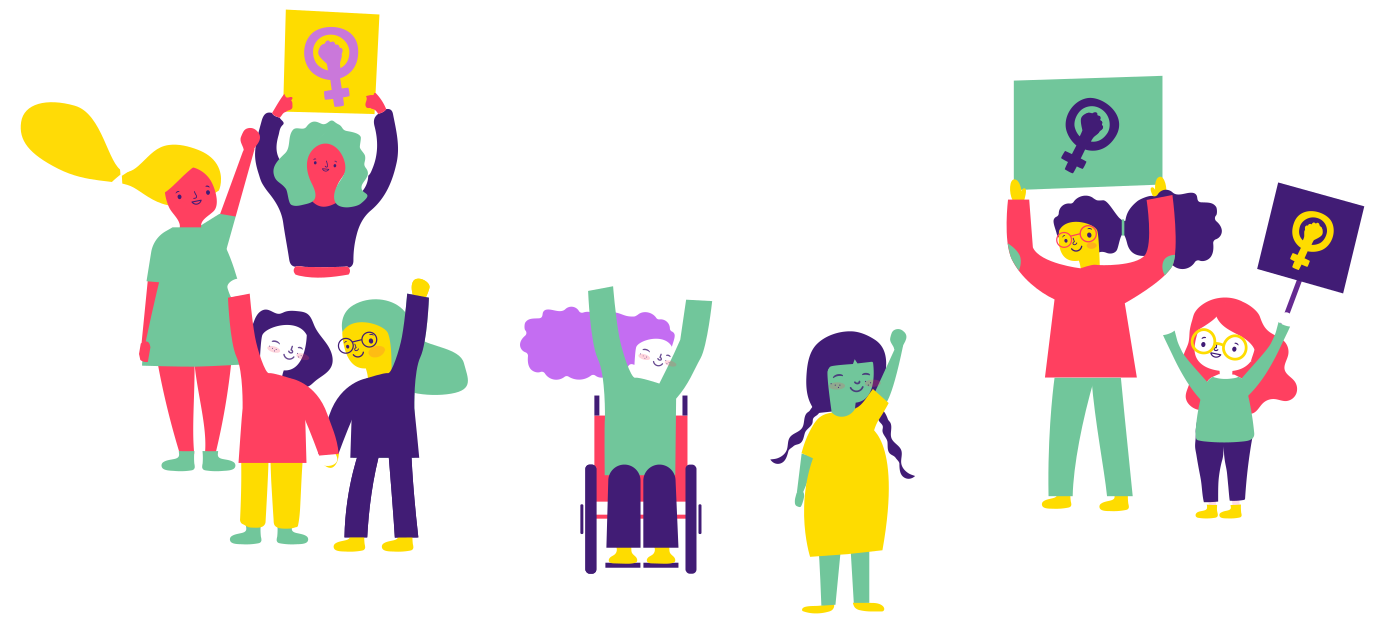
In the region, girls and young women face gender inequalities, violence, and discrimination that limit their development and the full exercise of their rights. To address these challenges, in 2020 we launched the Powerful Girls strategy, an intergenerational and intersectional movement that, in partnership with girls, adolescents, young women, and organizations, raises awareness of and combats the barriers that hinder their holistic development.

We provide tools and resources to civil society organizations so that they can address gender equality and the empowerment of girls and adolescents in their actions.
We work with governments and international organizations to promote public policies that guarantee the rights of girls and adolescents.
We raise public awareness about the importance of gender equality and the empowerment of girls and adolescents to advance towards gender equality.

Digital and Community Seeds: Projects created by teenagers and young people from Niñas Poderosas for cyberactivism and community action.
Publication of reports on inequalities and discrimination faced by girls and adolescents in the region.
Seminars and spaces for participation intergenerational and intersectional so that girls and adolescents can express their ideas and proposals.
Creation of resources and manuals for organizations that work with girls and adolescents.
Impact on public policies for the guarantee of the rights of girls and adolescents in several countries of the region.
Niñas Poderosas has established itself as a key initiative of Tejiendo Redes Infancia, promoting fairer and more equal societies for girls and young people in Latin America and the Caribbean.
During 2024 and 2025, we supported and empowered adolescent girls and young women in Argentina, Colombia, Chile, El Salvador, Guatemala, and Mexico with the necessary tools. We also spearheaded the creation of the Network of Organizations Promoting Empowered Girls, where women and organizations collaborate to foster inclusive and safe environments for girls, adolescents, and young women.

Since 2020 we have held intergenerational and intersectional dialogue spaces on the situation of girls in Latin America and the Caribbean in order to make their situation visible and to promote actions for their empowerment.
These meetings, facilitated by specialists and representatives of civil society organizations, including young participants, offer practical tools and spaces for dialogue to strengthen their capacity to generate changes in their communities.

Promote gender equality and the empowerment of girls and adolescents in the region.